
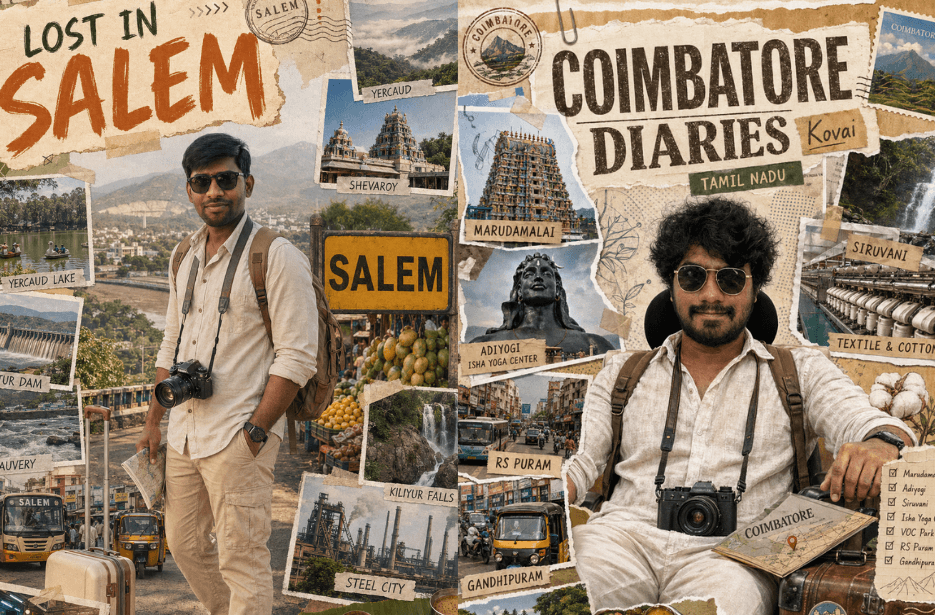
Travel posters have always captured the spirit of adventure, inviting us to explore new places through bold visuals and creative storytelling. Today, artificial intelligence has completely transformed how these posters are made, making it easier than ever to turn simple ideas into stunning designs. With the right prompts, you can generate everything from vintage-inspired destination ads to modern, eye-catching travel art in just minutes.
In this guide, you will learn how to craft effective AI prompts for travel posters, and bring your creative vision to life.
Variation 1: Coimbatore Diaries
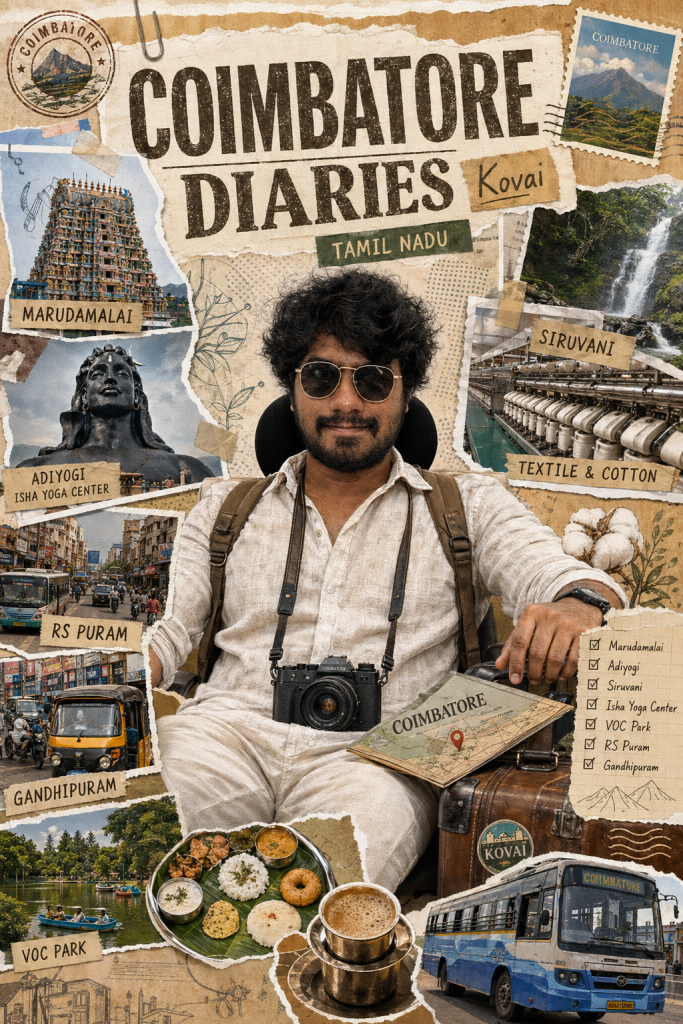
Use the provided reference image specifically for the main character (the tourist). The character must look like a stylish traveller (not a local), wearing modern global travel fashion such as a linen outfit, sneakers or boots, sunglasses, and carrying accessories like a camera, backpack, map, or suitcase.
The overall design should strongly resemble a handcrafted scrapbook collage, with layered paper cutouts, torn edges, taped photos, stickers, stamps, overlapping textures, doodles, and pasted travel memories. Make it feel like a curated travel journal page brought to life.
Surround the tourist with Coimbatore-specific elements:
Marudamalai Temple
Adiyogi statue at Isha Yoga Center
Western Ghats landscapes
Siruvani waterfalls and greenery
Textile and cotton industry visuals
RS Puram and Gandhipuram street scenes
Local buses and auto rickshaws
South Indian filter coffee and traditional meals
Blend realistic character detail with scrapbook-style collage elements like:
torn paper layers, masking tape effects, handwritten notes, postage stamps, halftone textures, grain overlays, and bold geometric accents.
TEXT RULE (STRICT):
All text must be in English only
Only Coimbatore-related words allowed
Main headline: “COIMBATORE DIARIES”
Supporting text can ONLY include:
“Coimbatore”, “Kovai”, “Tamil Nadu”, “Marudamalai”, “Adiyogi”, “Siruvani”, “Isha Yoga Center”, “VOC Park”, “RS Puram”, “Gandhipuram”
No unrelated text, no other cities, no Tamil script
Color palette: warm earthy tones (terracotta, muted greens, sunlit yellow) mixed with cool blues and subtle vintage paper textures.
Typography: bold editorial headline combined with handwritten scrapbook notes and stamped lettering.
Overall result: a visually rich, layered, scrapbook-inspired travel poster that feels personal, artistic, and print-ready, like a high-end travel journal page capturing the essence of Coimbatore.
Variation 2: Lost in Salem
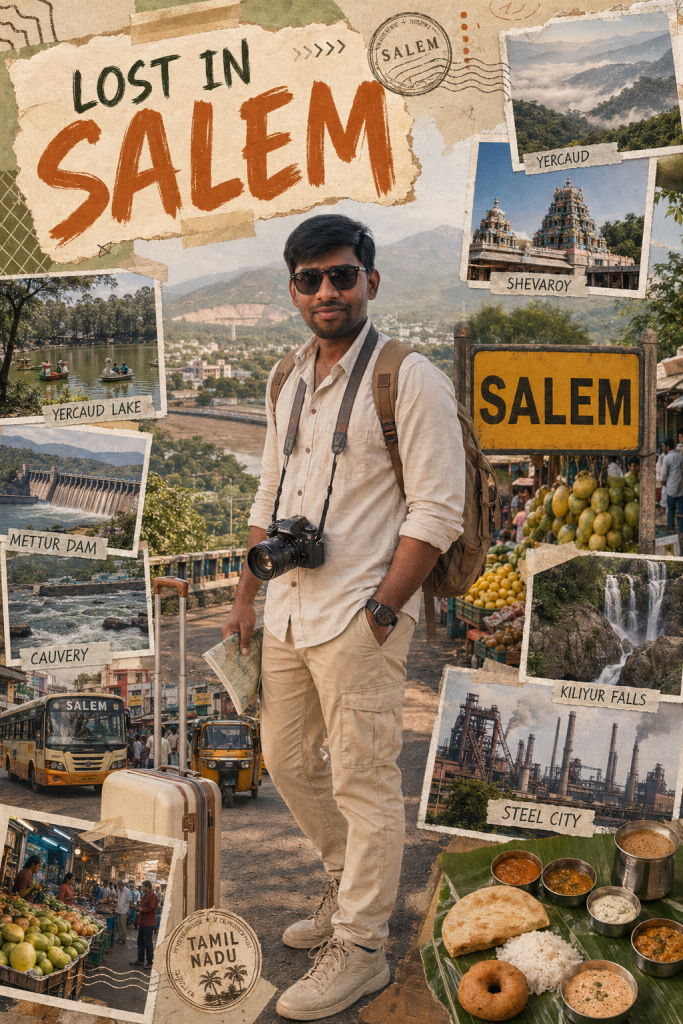
Use the provided reference image strictly for the main character (tourist). The character should appear as a modern traveller (not a local) wearing: a linen or neutral-toned travel outfit, sneakers or boots, sunglasses, and accessories like a camera, backpack, map, or suitcase.
SCENE STYLE (IMPORTANT CHANGE):
The environment must feel like a real, cohesive place, not separate photo cutouts.
All Salem elements should be blended into a single realistic background environment. Maintain depth, lighting consistency, and natural perspective. The scrapbook style should appear as overlays on top of a real scenic composition, not as floating photos
Include a visible Salem-style yellow road sign board that says: “SALEM”
BACKGROUND ELEMENTS (INTEGRATED NATURALLY INTO SCENE)
Seamlessly incorporate:
Yercaud hills and misty viewpoints
Shevaroy Temple
Yercaud Lake with boats
Kiliyur Falls
Mettur Dam and the Cauvery River
Salem steel plant / industrial structures
Mango trees/mango elements
Local markets and street life
Buses and auto rickshaws
South Indian meals and filter coffee
All elements should feel like they exist within the same environment (foreground, midground, background layering).
SCRAPBOOK COLLAGE LAYERING (OVERLAY STYLE)
Add handcrafted scrapbook aesthetics layered on top: torn paper edges, masking tape strips, travel stamps, handwritten doodles, stickers, halftone textures, grain and vintage paper overlays, geometric accents. These should enhance the composition without breaking realism.
TEXT RULE (STRICT)
All text must be in English only.
Main headline:
“LOST IN SALEM”
Only allowed supporting words:
Salem
Yercaud
Shevaroy
Kiliyur Falls
Mettur Dam
Cauvery
Tamil Nadu
Steel City
Yercaud Lake
No other words. No other cities. No Tamil script.
COLOR & STYLE
Warm earthy tones: terracotta, deep orange
Muted greens (hills, nature)
Cool blues (water, sky, mist)
Subtle vintage textures
Soft cinematic lighting with slight haze for hill atmosphere
FINAL LOOK
High-end editorial travel poster
Realistic yet artistic
Balanced between photoreal environment + scrapbook overlays
Print-ready composition
Feels like a luxury travel journal page brought to life
Variation 3: Tirunelveli is a Paradise
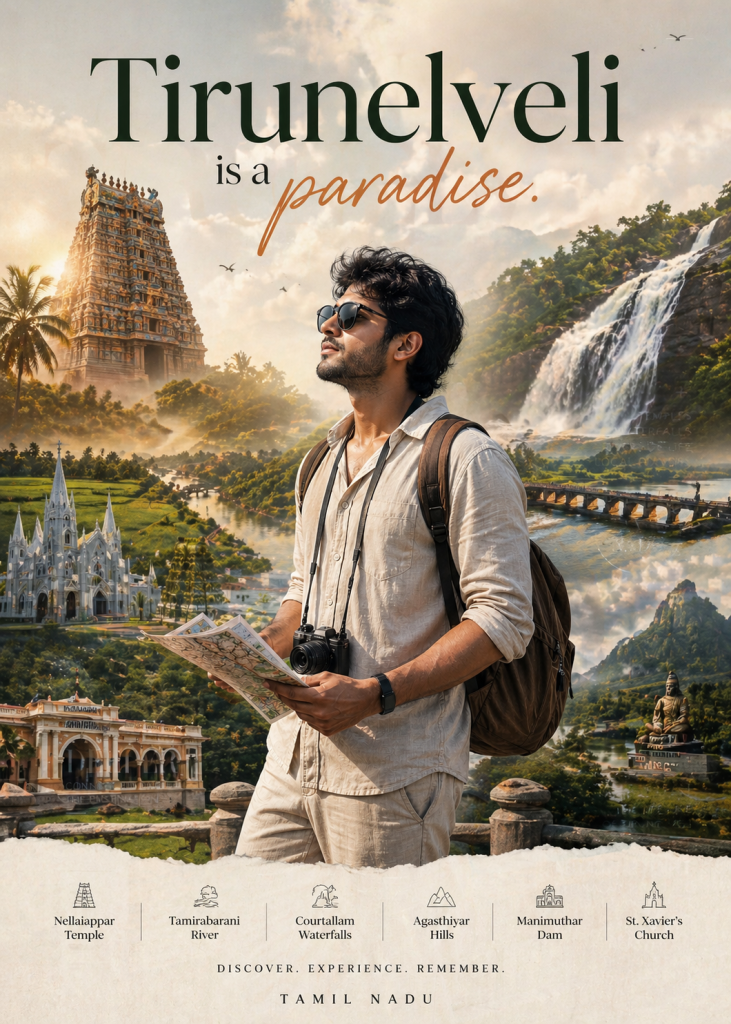
Use the provided reference image as the cover model (tourist). The character should look like a global luxury travel influencer—effortlessly stylish, natural, and candid.
Wardrobe styling:
premium neutral-toned outfit (linen or light cotton), clean silhouette, luxury sneakers or boots, sunglasses. Minimal accessories like a camera or leather backpack.
Lighting:
natural editorial lighting—soft golden-hour sunlight with realistic shadows, gentle highlights on skin, and accurate color tones. Avoid artificial or overly stylized lighting.
Background (IMPORTANT – Realistic Environmental Blend):
Create a single cohesive, photorealistic environment where multiple Tirunelveli landmarks exist naturally within the same geography (not collage, not separate frames).
Blend seamlessly:
Western Ghats and Agasthiyar hills forming the distant backdrop
A flowing Tamirabarani river in the mid-ground
Subtle architectural presence of Nellaiappar Temple integrated into the cityscape
A distant waterfall inspired by Courtallam emerging from the hills
Palm trees, greenery, and low-rise town structures completing the scene
All elements must share:
consistent lighting, perspective, atmospheric depth, and scale—so the scene feels like a real place captured in one shot.
Environment details:
light mist in hills, soft humidity in air, birds in distance, gentle wind movement in clothing, natural sky gradient.
Camera style:
shot on a full-frame DSLR or medium-format camera, 50mm or 85mm lens, shallow depth of field, sharp subject focus, natural background blur, high dynamic range.
Composition:
clean editorial magazine layout with strong grid alignment. Subject slightly off-center. Maintain negative space for typography.
Add realistic magazine elements:
barcode, issue number, minimal cover lines, subtle print texture—aligned with a premium international fashion magazine aesthetic.
TEXT RULE (STRICT):
Main headline: “TIRUNELVELI IS A PARADISE”
Supporting text only:
“Tirunelveli”, “Nellai”, “Courtallam”, “Agasthiyar”, “Tamirabarani”, “Tamil Nadu”, “Nellaiappar Temple”
No extra phrases, no unrelated text, no Tamil script.
Typography:
bold luxury editorial fonts (modern serif + clean sans-serif), refined spacing, realistic magazine hierarchy.
Color palette:
high-contrast neutrals with natural greens, river blues, and warm earthy tones. Skin tones must remain true and lifelike.
Final look:
should feel like a real, globally published fashion-travel magazine cover—photographically authentic, immersive, and believable, with Tirunelveli’s identity expressed through a unified, realistic landscape rather than collage elements.
Variation 4: Timeless Tanjore
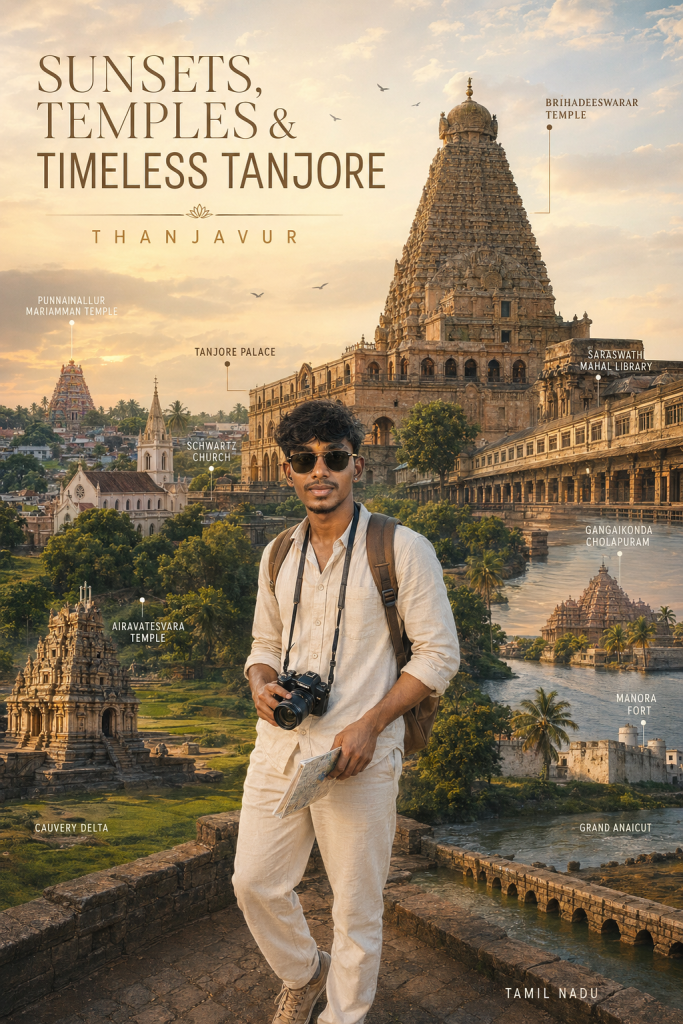
Use the provided reference image for the main character. The tourist must be placed at the center. The person should look ready to explore—confident, curious, and naturally engaged with the surroundings.
Styling:
modern global traveler aesthetic—light linen or cotton outfit, comfortable sneakers or boots, sunglasses. Accessories like a camera, backpack, or folded map in hand to suggest movement and exploration.
Scene Composition (IMPORTANT – Realistic Unified Environment):
Create a single, cohesive, photorealistic environment where multiple iconic places of Thanjavur exist naturally within one believable landscape (not collage, not separate frames).
Blend seamlessly into one scene:
Brihadeeswarar Temple as the dominant architectural centerpiece
Elements of Thanjavur Palace / Maratha Palace integrated into the surrounding structures
Saraswathi Mahal Library suggested through heritage-style architecture
Schwartz Church subtly visible in the mid-ground
Punnainallur Mariamman Temple as a distant temple structure
Hints of Gangaikonda Cholapuram / Airavatesvara Temple architectural style in the far background
Manora Fort suggested as a distant coastal-style structure (subtle, not dominant)
Grand Anaicut (Kallanai) influence through water channels or stone bridge elements
Flowing Cauvery/Vennar river cutting through the landscape
Lush Cauvery delta greenery, palm trees, and open skies
All elements must share:
consistent lighting, realistic scale, natural perspective, and atmospheric depth—so the entire scene feels like one real place captured in a single shot.
Environment Details:
warm South Indian climate, soft haze, birds in the sky, gentle wind in clothing, natural textures (stone, water, greenery).
Lighting & Camera:
golden hour or soft daylight
realistic shadows and highlights
shot on full-frame DSLR / mirrorless, 35mm or 50mm lens
sharp subject focus, subtle depth-of-field blur in background
Typography (Minimal & Premium):
Main headline: “SUNSETS, TEMPLES & TIMELESS TANJORE”
Supporting text only:
“Thanjavur”, “Brihadeeswarar Temple”, “Tanjore Palace”, “Saraswathi Mahal Library”, “Schwartz Church”, “Punnainallur Mariamman Temple”, “Gangaikonda Cholapuram”, “Airavatesvara Temple”, “Manora Fort”, “Grand Anaicut”, “Cauvery Delta”, “Tamil Nadu”
No extra text, no social media icons, no unrelated words.
Typography Style:
clean, modern editorial fonts (serif + sans-serif mix), minimal placement, elegant spacing.
Color Palette:
warm earthy tones, temple stone browns, golden sunlight, natural greens, soft sky blues. Skin tones must remain realistic.
Final Look:
a cinematic, photorealistic travel poster that feels authentic and immersive—capturing the essence of Thanjavur through a unified landscape, with the traveler at the center ready to explore, not staged or artificially composed.
How to Use These Prompts
1. Below each image, you will see a prompt box with two buttons: Copy and Share to AI.
2. You can tap Copy to copy the full prompt manually. Or simply tap Share to AI; this will automatically copy the prompt for you.
3. After tapping Share to AI, a list of popular AI tools like ChatGPT, Gemini, Copilot, and others will appear on your screen.
4. Click on any AI tool you prefer. It will directly open the selected AI platform.
5. Once the AI page opens, paste the prompt into the prompt box (it is already copied if you used Share to AI).
6. Upload your reference image if required.
7. Click generate, and your image will be created.
8. If needed, you can slightly adjust the prompt for lighting, angle, or mood and generate again.
9. Once you are satisfied with the result, download the image and save it for your use.
Tips to Generate Better Results!
1. Be very specific about the destination
Instead of saying “a beach poster,” mention details like “Bali beach at sunset with palm trees and golden reflections”. The more precise you are, the more accurate and visually rich the output will be.
2. Add an art style
AI responds strongly to style cues. Try phrases like vintage travel poster, minimalist design, cinematic illustration, watercolour painting, or retro 70s aesthetic to shape the look.
3. Describe the mood or feeling
Include emotional direction such as calm and dreamy, adventurous and bold, or luxury and relaxing. This helps the AI set the right tone.
4. Mention lighting and time of day
Lighting changes everything. Use terms like golden hour, soft morning light, neon night glow, or sunset haze to make your poster more dramatic and realistic.
5. Include composition details
Guide the layout by specifying things like a centred landmark, a wide landscape view, an aerial perspective, or symmetrical framing.
6. Add design elements
For a real poster feel, include elements like bold typography, space, travel stamp overlays, minimal text area, or retro colour palette.
7. Keep prompts structured
A simple format works best:
Subject + Location + Style + Mood + Lighting + Details
8. Experiment and refine
Don’t settle for the first result. Slightly adjust your prompts; changing one or two words can dramatically improve the output.